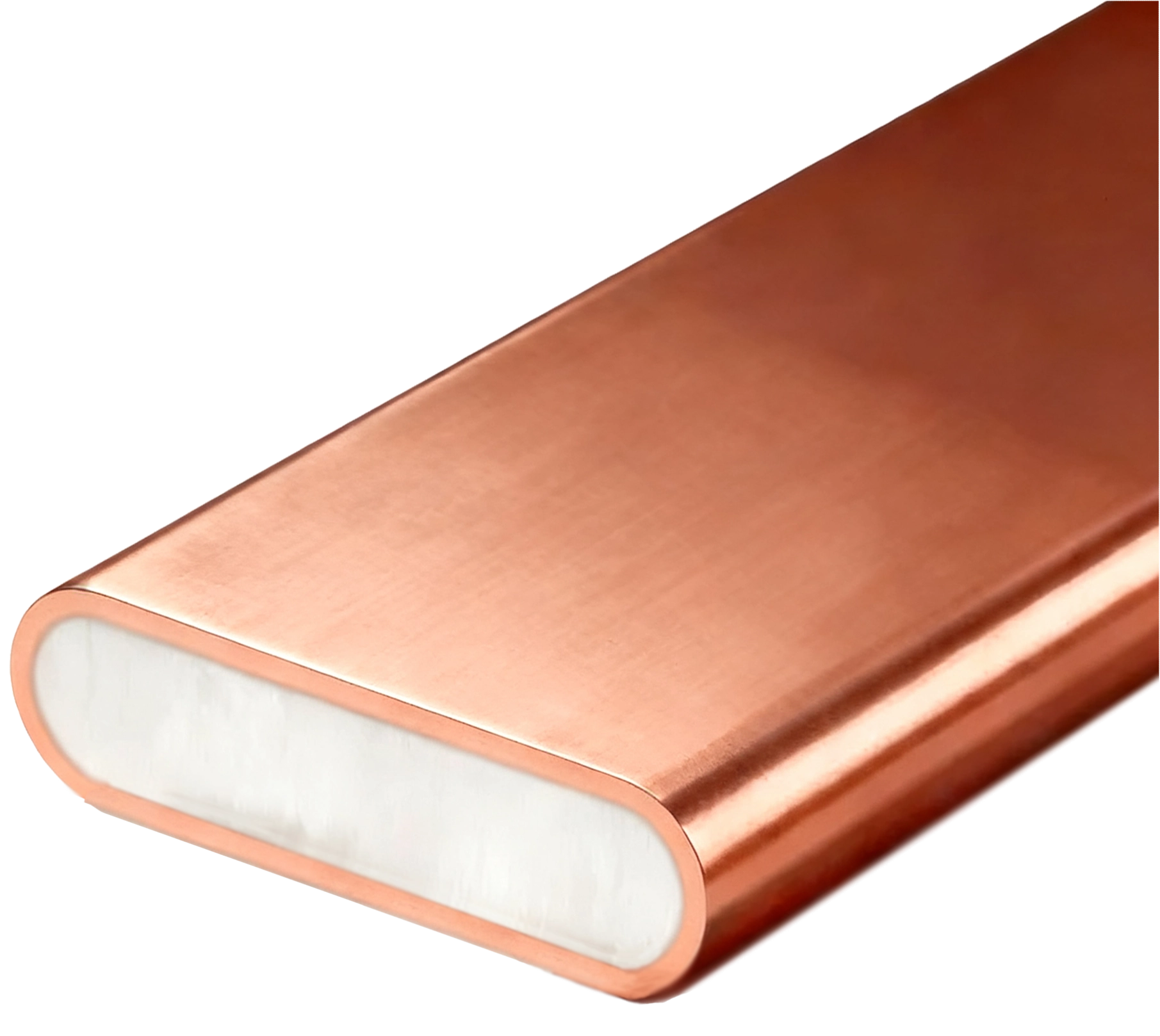
Rolling, slitting and dimensional control
Metallurgical Bond
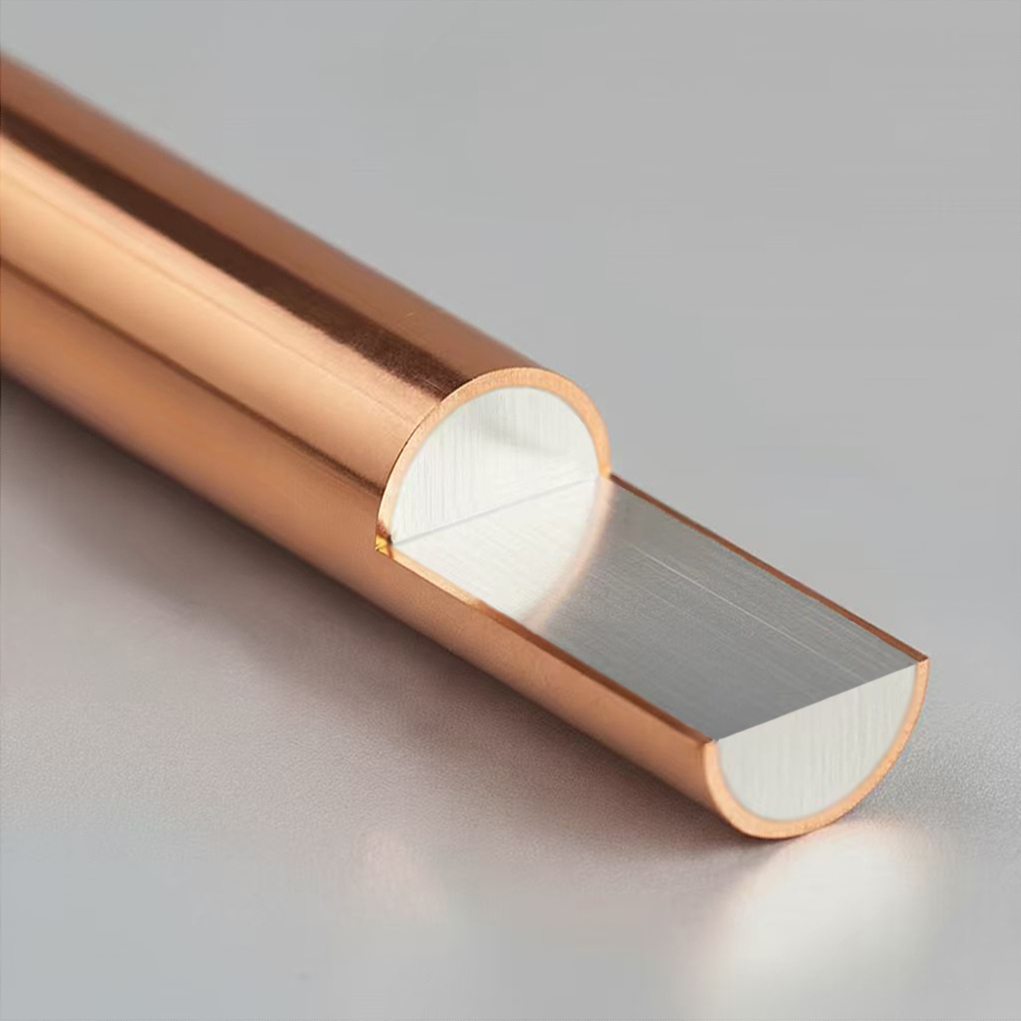
Our metallurgical bonding technology ensures a stable interface between different metals, verified by cross-section inspection.
Validation Capability
From Process Capability to Procurement Evidence
Raytron connects material selection, process control and inspection items to procurement specifications so engineering, quality and sourcing teams can align before RFQ.
| Stage | Key Checks | Evidence Buyers Should Request |
|---|---|---|
| Interface structure |
|
|
| Mechanical reliability |
|
|
| Application boundary |
|
|
Test Methods & Applicability
Bond Interface Evidence Modules
The following test items can be provided per product form, purchase specification and customer agreement. Unpublished data is available upon NDA / request. No fabricated data.
Metallographic Cross-Section
- Applicable Product
- CCA, CCS, NCC clad conductors
- Test Method
- Cross-section preparation and microscopic examination of interface continuity and diffusion layer
- Equipment
- Available upon NDA / request
- Sampling Frequency
- Per product control plan or qualification plan
- Typical Result
- Available upon NDA / request
- Acceptance Criterion
- Continuous bond line, no visible voids, inclusions or unbonded areas
- Reference Standard
- ASTM B748 / ISO 1463
- Limitations
- Sample preparation represents a specific cross-section, not full-length evaluation
EDS Line Scan
- Applicable Product
- CCA, CCS, NCC clad conductors
- Test Method
- Energy dispersive spectroscopy line scan across bond interface
- Equipment
- Available upon NDA / request
- Sampling Frequency
- Per qualification plan
- Typical Result
- Available upon NDA / request
- Acceptance Criterion
- Composition transition consistent with diffusion bond
- Reference Standard
- ISO 22309
- Limitations
- Semi-quantitative; requires calibration against reference samples
Layer Thickness Distribution
- Applicable Product
- CCA, CCS, NCC wire and strip
- Test Method
- Multi-point measurement of clad layer thickness on cross-section
- Equipment
- Available upon NDA / request
- Sampling Frequency
- Per product control plan
- Typical Result
- Available upon NDA / request
- Acceptance Criterion
- Per product specification and customer agreement
- Reference Standard
- ASTM B748 / ISO 1463
- Limitations
- Thickness may vary around circumference; reported as statistical range
Peel / Shear Test
- Applicable Product
- CCA, CCS, NCC clad conductors
- Test Method
- Peel or shear test of clad bond interface
- Equipment
- Available upon NDA / request
- Sampling Frequency
- Per product control plan or qualification
- Typical Result
- Available upon NDA / request
- Acceptance Criterion
- Per product specification and customer agreement
- Reference Standard
- Per product specification and customer agreement
- Limitations
- Test method and specimen geometry must be agreed; results are form-dependent
Bending Test
- Applicable Product
- CCA, CCS, NCC wire and strip
- Test Method
- Repeated bending or wrap test to assess interface integrity
- Equipment
- Available upon NDA / request
- Sampling Frequency
- Per product control plan
- Typical Result
- Available upon NDA / request
- Acceptance Criterion
- No delamination or cracking at bond interface
- Reference Standard
- ISO 7801 (where applicable)
- Limitations
- Bend radius and cycle count must match application condition
Thermal Cycling
- Applicable Product
- CCA, CCS, NCC clad conductors
- Test Method
- Thermal cycling across specified temperature range
- Equipment
- Available upon NDA / request
- Sampling Frequency
- Per qualification plan
- Typical Result
- Available upon NDA / request
- Acceptance Criterion
- No delamination, cracking, or resistance increase beyond limit
- Reference Standard
- IEC 60068-2-14
- Limitations
- Test profile must be agreed based on application environment
Electrical Resistivity Test
- Applicable Product
- CCA, CCS, NCC clad conductors
- Test Method
- DC resistance or conductivity measurement
- Equipment
- Available upon NDA / request
- Sampling Frequency
- Per product control plan
- Typical Result
- Available upon NDA / request
- Acceptance Criterion
- Per product specification (e.g., CCA 62–70% IACS)
- Reference Standard
- ASTM B193
- Limitations
- Measurement temperature and method must be specified
Inspection Report Sample
- Applicable Product
- All clad conductor products
- Test Method
- Combined inspection report per order
- Equipment
- N/A
- Sampling Frequency
- Per shipment or lot
- Typical Result
- Available upon NDA / request
- Acceptance Criterion
- Per purchase specification
- Reference Standard
- Per customer agreement
- Limitations
- Report content and format customizable; samples require NDA
Bonding Interface Characteristics
Metallurgical Integration
- • Direct diffusion bonding between metal layers
- • No intermediate adhesive or plating layers
- • Continuous, void-free interface
Mechanical Properties
- • Excellent peel strength and shear strength
- • Fatigue performance depends on conductor composition, form, bending radius and application conditions — application-specific testing recommended
- • Stable performance across temperature extremes
Quality Assurance
- • Interface inspected per product control plan (metallographic, peel or shear testing)
- • Statistical process control throughout production
- • Certified bond strength for each production batch
Interface Comparison
| Property | Metallurgical Bond | Electroplated |
|---|---|---|
| Bond Strength | Verified by peel/shear test | Lower; surface-dependent |
| Interface Continuity | Continuous | Often discontinuous |
| Thermal Stability | Excellent | Poor - delaminates |
| Corrosion Resistance | Excellent | Moderate |
Technology Deep Dive: Atomic Diffusion Mechanism
Unlike traditional processes that rely on surface roughness for mechanical interlocking, Raytron's metallurgical bond technology promotes the inter-diffusion of copper and aluminum atoms across the interface barrier by strictly controlling thermodynamic parameters during annealing. This diffusion creates a solid-solution transition layer with a composition gradient, effectively erasing the physical boundary.
Result: Reliable performance in the most demanding applications
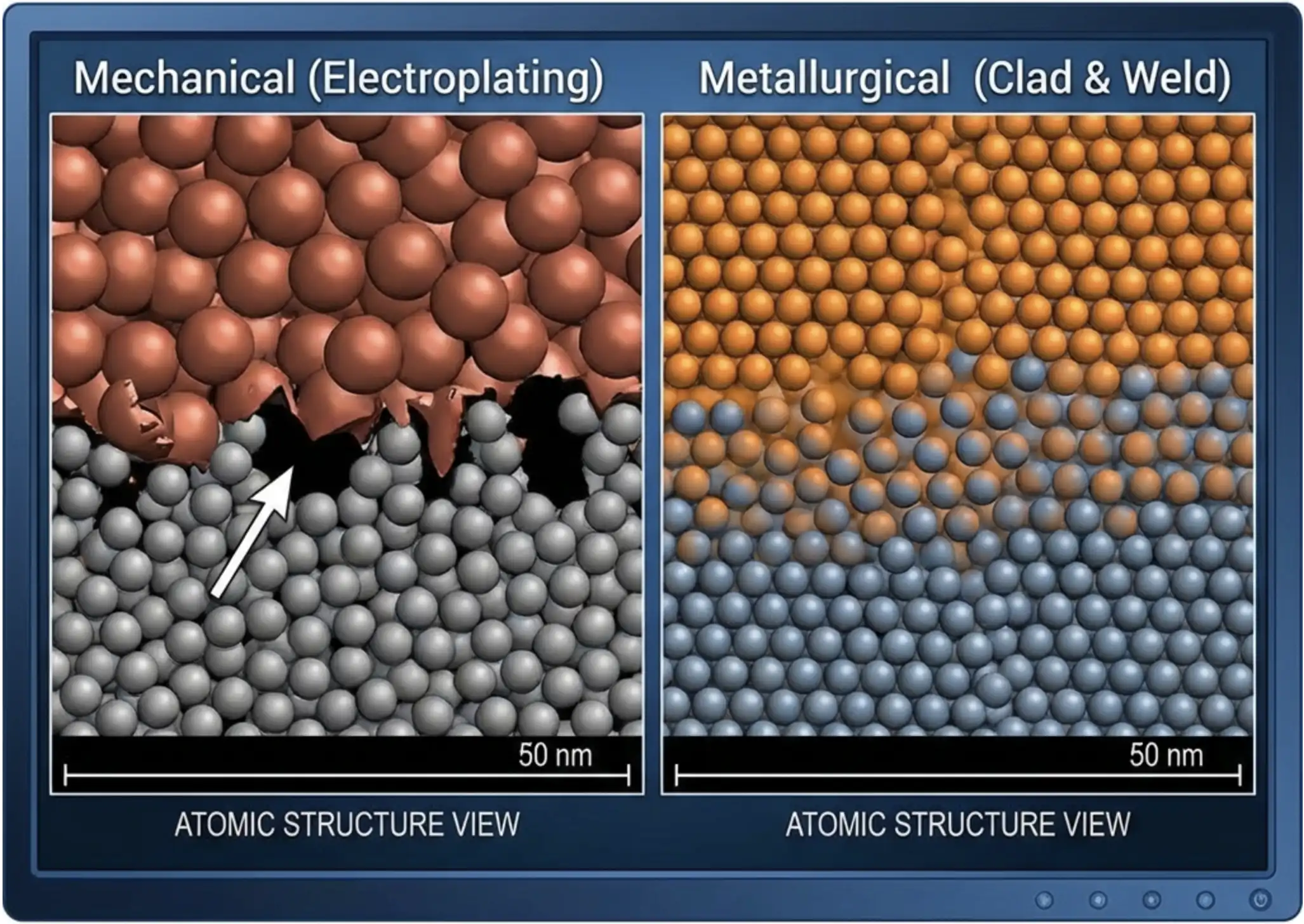
Microstructure Comparison
Simulated interface structure under high magnification
Mechanical Bond (Electroplating)
- Micro-gaps at interface
- Prone to galvanic corrosion
- Peels easily due to thermal expansion mismatch
Metallurgical Bond (Clad & Weld)
- Atomic inter-diffusion
- Reduces interface contact risk, confirmed by product testing
- Processable with standard bimetal operations; parameters must be validated
FAQ
Why is metallurgical bonding more reliable?
Does brittle compound form at the interface?
Products Utilizing This Technology