
Engineering Application Guide
Where CCA Fits and What to Check
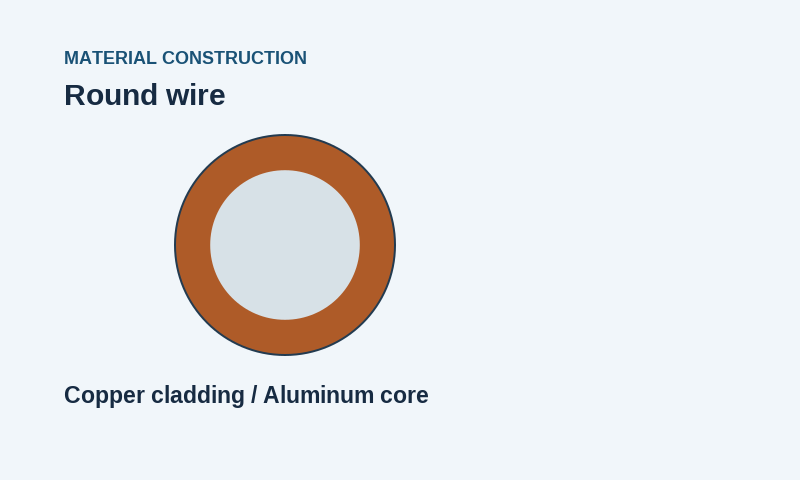
Start with the circuit, conductor shape and operating conditions you need to meet. Copper-clad aluminum (CCA) combines an aluminum core with a copper exterior; compare its required section, joints and test results before considering a copper substitution.
On this page
CCA Application Matrix
The table below maps each application to its typical CCA form, the main reason to evaluate, the key risk, the validation required and the review level. The review level is a reference value and must be assessed against project-specific conditions.
| Application | Typical CCA form | Main reason to evaluate | Key risk | Validation required | Review level |
|---|---|---|---|---|---|
| Coaxial / RF | Round / fine wire | Copper surface behavior at high frequency | Impedance and attenuation | DC resistance, impedance, TDR, bend | Established reference use; final cable validation |
| Communication cable | Round / stranded wire | Weight and cost balance | DC resistance and termination | Resistance, termination, aging | Application validation |
| Speaker wire | Stranded wire | Lower mass and copper usage | Loop resistance and connection | Loop resistance, flex, terminal test | Application validation |
| Lightweight harness | Round / stranded / application-specific flat | Weight-sensitive circuits | Crimp, voltage drop, corrosion | Crimp section, pull force, contact resistance, thermal rise | Engineering review |
| Motor winding | Enameled round / flat wire | Weight and slot-fill evaluation | Temperature rise, winding damage, insulation | Winding trial, resistance, thermal rise, aging | Engineering review |
| Composite PV ribbon | Flat / ribbon / busbar | Copper-saving module design | Solderability and module reliability | Resistance, coating, peel, TC, DH, EL | Module-level qualification |
| Antenna / electronics | Fine wire / foil / strip | Surface conductivity and low mass | Forming and contact | Solderability, bend, resistance | Application validation |
| EV high-current | Project-specific | Weight inquiry | Heat and qualification | Full system review | Controlled engineering inquiry |
| Aerospace / medical | Project-specific | Weight or surface inquiry | Certification and long-term reliability | Customer-controlled qualification | Customer-controlled material and end-product qualification |
Network conductors and metallic shielding tape
For CAT 5e / CAT 6, review the finished cable’s transmission requirements, DC resistance and unbalance, terminations and any PoE voltage-drop or temperature-rise duty. High-frequency surface conduction does not establish category compliance or powering performance.
CCA shielding tape is a separate metallic shield component. Define layer construction, thickness, width, overlap, continuity and connections; add fault-duty requirements where the shield carries fault current.
Prepare your application brief
CCA for Cable & Conductor
Typical use: Inner conductor or shield of coaxial, communication, speaker and signal cables.
Why evaluate: Compare the copper surface and complete conductor section at the actual signal frequency and required resistance. Check mass and cost only after cable requirements are met.
Key validation: DC resistance, impedance consistency, TDR, bending test, termination bond strength.
Recommended products: CCA round wire; conductivity and copper ratio confirmed by grade in the purchase specification.
CCA for Lightweight Wire Harness
Typical use: Weight-sensitive branches in vehicle and equipment harnesses.
Why evaluate: Compare conductor mass at the required circuit resistance and terminal geometry; a copper exterior does not establish crimp compatibility.
Key validation: Crimp terminal bond strength, thermal cycling, vibration, temperature rise.
Recommended products: CCA flat wire, dimensions and tolerances matched to the terminal.
CCA for Motor Windings
Typical use: Weight-sensitive motor windings (subject to heating and life validation).
Why evaluate: Assess winding mass together with the section needed for resistance, temperature rise and insulation performance.
Key validation: Thermal cycling, continuous-current temperature rise, insulation life, vibration.
Recommended products: CCA round wire (motor grade), reviewed with varnish and termination process.
CCA for Composite PV Ribbon
Typical use: Composite conductor base for PV module interconnect and busbar ribbon.
Why evaluate: Compare copper use and cost for the selected ribbon section, coating and module process; confirm solderability and thermal-fatigue acceptance.
Key validation: Solderability, peel strength, thermal cycling (IEC 61215 reference direction), bending.
Recommended products: CCA strip, coating and dimensions matched to cell process.
CCA for Electronics and Antenna Components
Typical use: Antenna radiators, EMI shielding, ground planes, lightweight electronic structural parts.
Why evaluate: Evaluate the copper surface at the operating frequency, then check resistance, forming and exposure in the component.
Key validation: Salt spray, adhesion, bending, vibration, visual inspection of interface corrosion.
Recommended products: CCA foil / strip, thickness and surface treatment matched to assembly process.
Optional: run the five-question review
Prepare a CCA Evaluation
Answer five questions to identify the specification, connection and testing information needed for your CCA evaluation. Use the result to prepare the next specification review.
Resolve the design constraints before substitution
- Application requires pure-copper conductivity (100% IACS) or low DC resistance
- Unvalidated high-current continuous load scenarios
- Harsh humidity or salt-spray environment without galvanic isolation designed in
- Safety-critical applications where substitution without project-level validation is not acceptable
- Buyer expects a drop-in replacement for copper without engineering review
- Termination method (crimp / solder / weld) has not been validated for bond strength
- Outdoor exposure needs galvanic isolation; direct burial also needs moisture protection.
Design targets to include in the review
- Weight reduction is a primary design goal (Calculated by rule of mixtures: about 3.326 g/cm³ at 10% copper by volume, about 3.639 g/cm³ at 15% (calculated, not measured).)
- Confirm the operating frequency, resistance and signal requirements.
- Cost reduction vs pure copper is required and a conductivity trade-off is acceptable (Conductivity depends on the CCA grade and specification. Confirm the applicable grade and measured values per product and lot in your RFQ.)
- The application can be validated through sample testing and a pilot batch
Calculated material examples and their assumptions
Calculation Basis
Values shown are for engineering reference only. Equal dimensions do not mean equal resistance, ampacity or temperature rise. Equivalent-current designs may require a larger conductor cross-section. Final values must be confirmed in the purchase specification.
Recommended CCA Validation Route
Define application requirements
Define rated current, ambient temperature, humidity, chemical exposure, design life and failure criteria.
Confirm conductor geometry
Determine form (round / flat / strip / foil), dimensions and tolerances matched to terminals and assembly.
Confirm copper ratio
Confirm the copper ratio (stating whether it is by cross-sectional area or by weight) and the corresponding conductivity, then lock both in the purchase specification.
Review joining method
Review crimp, solder or weld process and confirm terminal specification and bond strength requirements.
Review service environment
Review temperature range, humidity, salt spray, vibration and chemical media; design galvanic isolation where required.
Produce sample
Sample from the production line so the sample represents the production process (cladding, annealing, drawing, slitting).
Run validation tests
Run electrical, mechanical and environmental tests: DC resistance, impedance, bending, thermal cycling, salt spray, vibration.
Approve pilot batch
Approve a pilot batch before mass production and lock the control plan and acceptance criteria.
CCA Application RFQ Checklist
Basic
- • Application and function
- • Annual volume and batch plan
- • Target lead time
- • Target price or cost-reduction target
Geometry
- • Form (round / flat / strip / foil)
- • Key dimensions and tolerances
- • Length or coil weight
Joining
- • Joining method (crimp / solder / weld)
- • Terminal model and specification
- • Bond strength requirement
Environment
- • Operating temperature range
- • Humidity and salt-spray exposure
- • Chemical media contact
Validation
- • Required tests
- • Standards referenced (ASTM B566, IEC 60228, GB 29197, UL 758 or mutually agreed methods)
- • Acceptance criteria
Choose the Right CCA Product Form
| Requirement | Recommended product form | Note | Link |
|---|---|---|---|
| Need a lightweight round conductor | CCA round wire | For coaxial, communication, speaker, motor winding | View product |
| Need a space-efficient flat conductor | CCA flat wire | For harness, FFC, EV lightweight branches | View product |
| Need a busbar / strip conductor | CCA strip | For PV ribbon, busbar, connectors | View product |
| Need thin foil for EMI shielding | CCA foil | For electronic shielding, antenna, ground plane | View product |
| Need composite PV ribbon | Composite PV ribbon (CCA base) | For PV module interconnect | View product |
| Need a high-frequency signal conductor | CCA round wire (skin effect) | For RF, coaxial, antenna | View product |
| Need lightweight winding wire | CCA round wire (motor grade) | For weight-sensitive motor windings | View product |
FAQ
Can CCA replace pure copper directly? +
No. CCA is not a universal drop-in replacement for pure copper. CCA conductivity is lower than copper and depends on grade and specification, its calculated density is lower than copper, and termination and corrosion behaviour differ from copper. Substitution requires application-level engineering validation with measured values confirmed in the purchase specification.
What applications are most suitable for CCA? +
CCA is suitable for high-frequency signal conductors that exploit skin effect (coaxial, RF, antenna), weight-sensitive lightweight harnesses and motor windings, and composite PV ribbon where a conductivity trade-off is acceptable. All applications should be validated first.
What are the main risks when using CCA? +
Main risks include: DC resistance higher than copper leading to heating; insufficient termination bond strength; interface corrosion in humid or salt-spray environments; and an expectation of drop-in replacement without engineering review.
What should be tested before mass production? +
We recommend testing DC resistance, impedance consistency, bending, thermal cycling, salt spray (if applicable), vibration (if applicable) and termination bond strength. The validation scope should match the service environment.
Is CCA suitable for outdoor use? +
CCA is not recommended for direct outdoor exposure without galvanic isolation. Outdoor applications should include moisture protection and isolation, and should pass salt-spray and interface-corrosion validation.
What information is required for a CCA RFQ? +
Provide the application, annual volume, form (round / flat / strip / foil), dimensions and tolerances, joining method, service environment, required tests and standards referenced.
Need to evaluate CCA for your application?
Send the drawing, required resistance, joining method and operating environment. Confirm the sample scope and acceptance tests before discussing production supply.
Submit CCA Application RFQ