
Copper winding materials
Copper Foil for Transformer Windings

Rolled copper foil provides the current-carrying layers in a foil-wound coil. Select thickness and width for the winding design, then specify temper, edge condition and insulation requirements. For high-frequency designs, assess winding losses using the actual layer arrangement and operating frequency.
On this page
Construction and specification
Scroll horizontally to read all columns.
| Item | Specification |
|---|---|
| Material construction | Specified copper grade and temper |
| Product form | Rolled foil |
Build the winding and terminal exit together
The foil turn, interlayer insulation, turn count and terminal exit form the transformer winding stack. Thickness and width describe only the metallic layer.
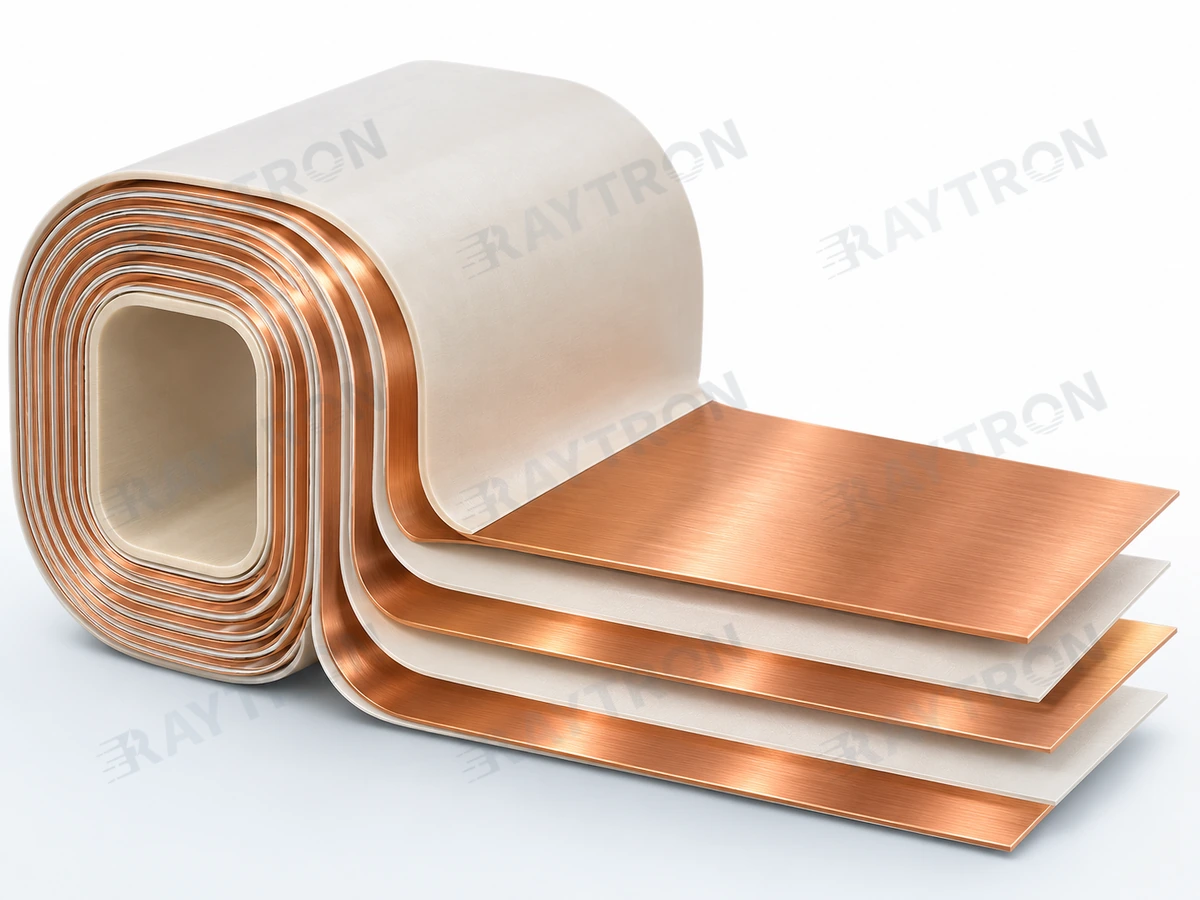
State grade, temper, edges, surface and roll handling together with waveform, current and cooling. Keep DC resistance and AC winding loss as separate checks.
Transformer foil-winding applicationSpecification design factors
Drawing-defined specification
Geometry and performance
- Gauge, usable width and surface condition define the thin conductor layer.
- Edge quality and winding tension affect tracking and handling.
- Core size and roll build govern unwinding on the downstream equipment.
Selection and processing
At high frequency, winding geometry and the arrangement of layers affect AC loss as well as DC resistance. Include frequency, waveform, insulation, winding tension and lead connections with the foil drawing; compare the assembled coil at the required temperature rise.
Material and form references
Foil specifications identify thickness distribution, usable width, surface condition, pinholes and roll handling. Agree the inspection method for the foil construction and downstream process.
Standards and product formsProduct questions
What affects foil handling and surface performance?
Gauge, usable width and edge quality influence tracking and damage during unwinding. Surface texture and cleanliness affect the downstream bond or contact. Core size, roll build and tension connect the foil to the processing equipment.
Which material condition belongs with an electrical value?
Keep the metal grade, temper, geometry, measurement temperature and method with the value. Surface plating or insulation is a separate construction feature; a family name alone does not define the finished part.
Which dimensions describe foil supplied on a roll?
Specify foil gauge and usable width together with edge condition. The roll record separately identifies core size, roll outside diameter, winding direction and any joints; these are different from foil thickness.
Related products
Prepare your inquiry
- Width, thickness and tolerances
- Edge condition, burr, surface and roll dimensions
- Metal grade and temper
- Surface finish or coating, joining method and inspection requirements
- Quantity, spool or coil format, packaging and delivery destination