
中文
Send an Inquiry

Materials, Product Forms and Specifications

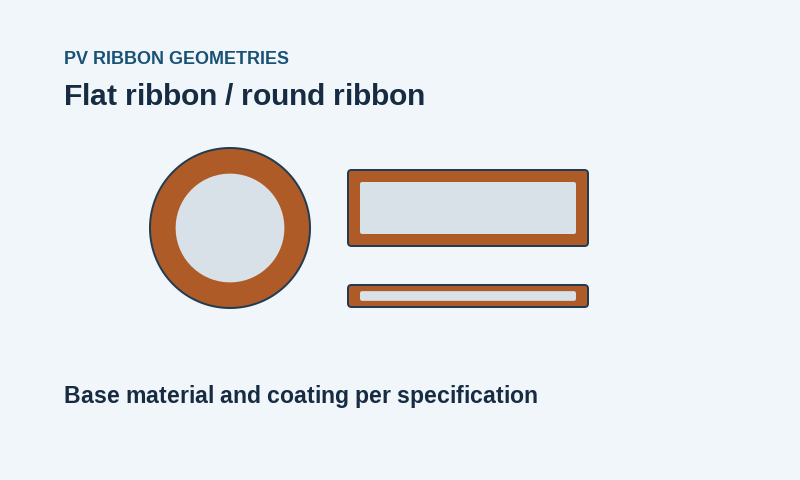
Product cross-sections for photovoltaic connections

Find the conductor structure and product form for your application. Each entry links to the product page and lists the dimensions, surface requirements and test information to include in your inquiry.

Copper-Aluminum Composite PV Ribbon & Busbar Ribbon

Request family information

Copper-Aluminum Composite PV Ribbon

Raytron’s copper-aluminum composite ribbon is designed for solar-module interconnection with reduced copper use. Choose the conductor section and solder coating for the cell layout and stringing process, then assess resistance, joint strength and module reliability against the existing ribbon design.

Construction form: PV ribbon

Applications, boundaries and standards
Primary applications
  • PV module interconnection
  • Solar cell stringing
  • Copper-saving module designs
  • TOPCon and mainstream module evaluation
Application boundaries
  • Width, thickness and edge geometry define a narrow flat conductor.
  • Metal layers and solder or insulation coatings perform different functions.
  • Spool format, winding tension and joining behavior connect the material to the assembly process.

Copper-Aluminum Composite Busbar Ribbon

Composite busbar ribbon collects current between cell strings and module connections. Its copper-aluminum construction reduces copper use compared with an all-copper conductor of the same size. Select the section and solder coating around the module current path, joint design and soldering process.

Construction form: Busbar ribbon

Applications, boundaries and standards
Primary applications
  • PV module busbar
  • Junction box connection
  • String current collection
  • Copper-saving module architecture
Application boundaries
  • Width, thickness and edge geometry define a narrow flat conductor.
  • Metal layers and solder or insulation coatings perform different functions.
  • Spool format, winding tension and joining behavior connect the material to the assembly process.

Copper-Aluminum Composite Interconnect Ribbon

Composite interconnect ribbon joins solar cells into strings using a copper-aluminum conductor with a solderable surface. Ribbon geometry, coating and mechanical properties need to work with the cell layout and stringer. Send the cell drawing, process window and spool requirements to discuss samples.

Construction form: Interconnect ribbon

Applications, boundaries and standards
Primary applications
  • Solar cell stringing
  • Cell-to-cell interconnection
  • PV ribbon substitution evaluation
Application boundaries
  • Width, thickness and edge geometry define a narrow flat conductor.
  • Metal layers and solder or insulation coatings perform different functions.
  • Spool format, winding tension and joining behavior connect the material to the assembly process.

Copper-Aluminum Composite Round Solar Ribbon

This round solar conductor uses a copper-aluminum composite core with a solderable surface. Specify finished diameter, coating, mechanical properties and spool format for the cell layout and stringer. Compare resistance and module performance with the existing conductor before approving the change.

Construction form: Round solar ribbon

Applications, boundaries and standards
Primary applications
  • Solar round ribbon
  • PV module interconnection
  • Copper-saving solar conductor evaluation
Application boundaries
  • Diameter and ovality determine the metal section and fit in the finished assembly.
  • Resistance depends on material, section, length and temperature.
  • Temper and surface condition affect drawing, bending and joining.

Copper Clad Aluminum Conductors

Request family information

CCA Round Wire

Copper-clad aluminum round wire combines a copper surface with a lightweight aluminum core. It serves cable designs whose governing standards permit CCA, with the conductor role, section and connection matched to the electrical duty.

Construction form: Round wire

Applications, boundaries and standards
Primary applications
  • CATV coaxial cable
  • Ethernet cable evaluation
  • Communication conductors
  • Lightweight wiring
Application boundaries
  • Diameter and ovality determine the metal section and fit in the finished assembly.
  • Resistance depends on material, section, length and temperature.
  • Temper and surface condition affect drawing, bending and joining.
Relevant standards
  • ASTM-B566 — Bare round CCA · B566-04a(2025)

    ASTM B566-04a(2025) covers bare round copper-clad aluminum wire, with classes and requirements for the single-wire construction.

CCA Flat Wire

CCA flat wire combines an aluminum core with copper cladding in a rectangular section. It is an option for coils and compact conductive parts where lower conductor weight matters. Compare the finished winding resistance, available space and connections when selecting it against copper.

Construction form: Flat wire

Applications, boundaries and standards
Primary applications
  • Voice coil evaluation
  • Inverter magnetic components
  • Medium-small motor windings
  • Lightweight conductive parts
Application boundaries
  • Width, thickness and corner shape define the conductor envelope.
  • Camber, twist and bend direction affect winding and automated feeding.
  • The metal section and any insulation build occupy separate parts of the finished envelope.

CCA Foil

CCA foil has copper cladding on an aluminum core in a thin rolled form. For transformer and inductor windings, select the foil section around the required resistance, winding space and joining method. Include edge quality, surface finish and roll format in the specification.

Construction form: Foil

Applications, boundaries and standards
Primary applications
  • High-frequency transformer windings
  • PV and storage inverter inductors
  • Lightweight foil conductors
Application boundaries
  • Gauge, usable width and surface condition define the thin conductor layer.
  • Edge quality and winding tension affect tracking and handling.
  • Core size and roll build govern unwinding on the downstream equipment.

CCA Strip

CCA strip is a rolled conductor with copper cladding on an aluminum core. For formed or stamped electrical parts, specify width, thickness, copper ratio and edge condition, then include the bend and joining requirements from the part drawing.

Construction form: Strip

Applications, boundaries and standards
Primary applications
  • Electronic shielding
  • Heat sinks
  • Connectors
Application boundaries
  • Thickness, width and temper govern forming and stamping behavior.
  • Edge profile, burr direction and rolling direction affect the finished part.
  • Surface and joining conditions determine electrical contact at the connection.

Copper Clad Steel Conductors

Request family information

CCS Round Wire

CCS round wire combines a steel core with copper cladding. Select the conductor by its tensile requirement, conductivity grade and copper-layer specification. For grounding, include fault-current duty and corrosion conditions; for signal cable, include frequency and cable construction.

Construction form: Round wire

Applications, boundaries and standards
Primary applications
  • Grounding
  • Lightning protection
  • Coaxial cable inner conductors
  • Signal wires in vibration environments
Application boundaries
  • Diameter and ovality determine the metal section and fit in the finished assembly.
  • Resistance depends on material, section, length and temperature.
  • Temper and surface condition affect drawing, bending and joining.
Relevant standards
  • ASTM-B227 — Hard-drawn round CCS · B227-15(2024)

    ASTM B227-15(2024): hard-drawn bare round CCS wire; ASTM B452-22(2026): bare round CCS for electronic applications. Select the applicable grade, condition and purpose.

  • ASTM-B452 — Electronic round CCS · B452-22(2026)

    ASTM B227-15(2024): hard-drawn bare round CCS wire; ASTM B452-22(2026): bare round CCS for electronic applications. Select the applicable grade, condition and purpose.

CCS Stranded Wire

CCS stranded conductors combine copper-clad steel wires in a defined strand construction. Specify strand count, individual wire size, overall diameter and lay, together with the tensile and resistance requirements. Include connection and corrosion conditions for grounding work.

Construction form: Stranded wire

Applications, boundaries and standards
Primary applications
  • Grounding networks
  • Telecom grounding
  • Infrastructure conductors
  • Cable conductor systems
Application boundaries
  • Wire count, single-wire diameter and lay define the complete strand.
  • Finished-strand resistance and breaking load describe the assembled conductor.
  • Layer arrangement, bending and terminal geometry determine handling and connection performance.
Relevant standards
  • ASTM-B228 — Concentric-lay CCS strand reference · B228-26

    Use only where the actual concentric-lay-stranded CCS construction matches the specified edition and contract. Select any single-wire material reference separately; finished strand and complete cable acceptance remain separate.

CCS Narrow Foil

CCS narrow foil combines a steel core with copper cladding in a thin slit form. Specify the strength, electrical and surface requirements for the finished part, together with thickness, slit width and edge condition.

Construction form: Narrow foil

Applications, boundaries and standards
Primary applications
  • Electronic component leads
  • Connector terminals
  • Shaped high-strength conductors
Application boundaries
  • Gauge, usable width and surface condition define the thin conductor layer.
  • Edge quality and winding tension affect tracking and handling.
  • Core size and roll build govern unwinding on the downstream equipment.

Nickel Clad Copper Conductors

Request family information

NCC Round Wire

NCC round wire has a copper core with nickel cladding. Select the construction around the required resistance, joining method and service environment. For elevated-temperature use, include the temperature profile, exposure time and insulation system in the specification.

Construction form: Round wire

Applications, boundaries and standards
Primary applications
  • High-temperature sensors
  • Lighting lead-in wire
  • Chemical process conductors
  • Engine compartment wiring
Application boundaries
  • Diameter and ovality determine the metal section and fit in the finished assembly.
  • Resistance depends on material, section, length and temperature.
  • Temper and surface condition affect drawing, bending and joining.
Relevant standards
  • ASTM-B355 — Nickel-coated soft/annealed round copper · B355-11(2024)

    ASTM B355-11(2024) concerns nickel-coated soft or annealed round copper wire. Its construction and nickel mass classes apply to that defined round-wire product.

NCC Strip

NCC strip combines a copper core with nickel cladding for conductive parts that need a nickel joining or contact surface. For battery and other electrical connections, specify strip dimensions, layer construction and the mating materials, then define the welding and operating requirements.

Construction form: Strip

Applications, boundaries and standards
Primary applications
  • Lithium battery tabs
  • Energy storage connections
  • Chemical process connections
  • Hydrogen-related evaluation
Application boundaries
  • Thickness, width and temper govern forming and stamping behavior.
  • Edge profile, burr direction and rolling direction affect the finished part.
  • Surface and joining conditions determine electrical contact at the connection.

NCC Foil

NCC foil combines a copper core with nickel cladding in a thin rolled form. It is considered where a conductive core and a nickel contact or joining surface are needed. Specify foil dimensions, nickel-layer construction, surface condition and the intended joining process.

Construction form: Foil

Applications, boundaries and standards
Primary applications
  • Battery connection layers
  • Harsh-environment electrical parts
  • Chemical resistant conductive foils
Application boundaries
  • Gauge, usable width and surface condition define the thin conductor layer.
  • Edge quality and winding tension affect tracking and handling.
  • Core size and roll build govern unwinding on the downstream equipment.

Silver Clad Copper Conductors

Request family information

SCC Wire

Custom conductor design

Silver-clad copper wire combines a copper core with a silver outer layer for custom contact and signal-conductor designs. Wire geometry and the surface layer follow the electrical path.

Construction form: Wire

Applications, boundaries and standards
Primary applications
  • High-end electrical contacts
  • High-frequency conductors
  • Premium electronic connections
Application boundaries
  • Diameter and ovality determine the metal section and fit in the finished assembly.
  • Resistance depends on material, section, length and temperature.
  • Temper and surface condition affect drawing, bending and joining.
Relevant standards
  • ASTM-B298 — Silver-coated soft/annealed round copper · B298-12(2024)

    ASTM B298-12(2024) concerns silver-coated soft or annealed round copper wire. Classes use silver mass percentage; layer thickness also depends on wire geometry.

SCC Strip

Custom conductor design

Silver-clad copper strip combines a copper core with a silver contact surface for custom formed electrical parts. Temper, strip geometry and surface coverage connect the material to the contact design.

Construction form: Strip

Applications, boundaries and standards
Primary applications
  • Premium electrical contacts
  • Electronic connection strips
  • High-frequency contact components
Application boundaries
  • Thickness, width and temper govern forming and stamping behavior.
  • Edge profile, burr direction and rolling direction affect the finished part.
  • Surface and joining conditions determine electrical contact at the connection.

SCC Foil

Custom conductor design

Silver-clad copper foil combines a copper core with a silver surface for custom conductive and contact-layer designs. Its thin geometry serves formed, bonded or layered parts.

Construction form: Foil

Applications, boundaries and standards
Primary applications
  • Premium conductive foil
  • High-frequency shielding evaluation
  • High-end electronic connections
Application boundaries
  • Gauge, usable width and surface condition define the thin conductor layer.
  • Edge quality and winding tension affect tracking and handling.
  • Core size and roll build govern unwinding on the downstream equipment.

Enameled Bimetal Conductors

Request family information

Enameled CCA Wire

Custom conductor design

Custom enameled CCA round-wire designs combine a copper-clad aluminum conductor with electrical insulation. Conductor diameter and insulation build define the finished winding wire.

Construction form: Enameled round wire

Applications, boundaries and standards
Primary applications
  • Voice coils
  • Small motor windings
  • Appliance compressor evaluation
  • Lightweight coil systems
Application boundaries
  • Diameter and ovality determine the metal section and fit in the finished assembly.
  • Resistance depends on material, section, length and temperature.
  • Temper and surface condition affect drawing, bending and joining.

Enameled CCA Flat Wire

Custom conductor design

Custom enameled CCA flat-wire designs combine an aluminum core, copper cladding and electrical insulation in a rectangular section. The bare metal and insulation envelope perform separate roles in the winding.

Construction form: Enameled flat wire

Applications, boundaries and standards
Primary applications
  • PV and storage inverter inductors
  • Two-wheeler motor windings
  • Compressor windings
  • Compact magnetic components
Application boundaries
  • Width, thickness and corner shape define the conductor envelope.
  • Camber, twist and bend direction affect winding and automated feeding.
  • The metal section and any insulation build occupy separate parts of the finished envelope.

Enameled Bimetal Precision Flat Wire

Custom conductor design

Custom enameled bimetal flat-wire designs combine a clad metal conductor with electrical insulation. The metal construction and finished insulation envelope work together within the winding.

Construction form: Precision flat wire

Applications, boundaries and standards
Primary applications
  • High fill-factor windings
  • Inverter magnetic components
  • Motor windings
  • Voice coil systems
Application boundaries
  • Width, thickness and corner shape define the conductor envelope.
  • Camber, twist and bend direction affect winding and automated feeding.
  • The metal section and any insulation build occupy separate parts of the finished envelope.

Supporting Pure Copper / Pure Aluminum Rolled Materials

Request family information

Rolled Copper Foil for Transformer Windings

Rolled copper foil provides the current-carrying layers in a foil-wound coil. Select thickness and width for the winding design, then specify temper, edge condition and insulation requirements. For high-frequency designs, assess winding losses using the actual layer arrangement and operating frequency.

Construction form: Rolled foil

Applications, boundaries and standards
Primary applications
  • High-frequency transformer windings
  • OBC/DCDC foil windings
  • Switching power supply windings
Application boundaries
  • Gauge, usable width and surface condition define the thin conductor layer.
  • Edge quality and winding tension affect tracking and handling.
  • Core size and roll build govern unwinding on the downstream equipment.

Precision Copper Flat Wire for Voice Coils

Copper flat wire provides a compact conductor section for voice coils and sensor windings. Specify the width, thickness, corner shape and surface condition to suit the winding process. Include the resistance target, insulation requirements and supply format.

Construction form: Flat wire

Applications, boundaries and standards
Primary applications
  • Voice coils
  • Industrial sensor coils
  • High-end audio coils
Application boundaries
  • Width, thickness and corner shape define the conductor envelope.
  • Camber, twist and bend direction affect winding and automated feeding.
  • The metal section and any insulation build occupy separate parts of the finished envelope.

Aluminum Foil for Transformer Windings

Aluminum winding foil is used to form the current-carrying layers of a transformer coil. Specify the alloy, foil dimensions, edge condition and coil format, then match the winding and joining process to the transformer design.

Construction form: Foil

Applications, boundaries and standards
Primary applications
  • Dry-type transformers
  • Distribution transformer windings
  • Cost-sensitive foil windings
Application boundaries
  • Gauge, usable width and surface condition define the thin conductor layer.
  • Edge quality and winding tension affect tracking and handling.
  • Core size and roll build govern unwinding on the downstream equipment.

Raytron — Engineering Every Micron.

Send the material, drawing, dimensions, quantity and intended use. Add the joining, inspection and delivery requirements you know so the specification and the next step for samples or a quote can be identified.

RFQ Request Quote Discuss your specification WhatsApp
Request Quote WhatsApp